
AI Agents vs Traditional Automation: What’s the Difference and Which Do You Need?
A founder’s guide to the real difference between AI agents and traditional automation, with examples, mistakes to avoid, and how to pick.

By Prabhat Patra
Updated on Jul 17, 2026
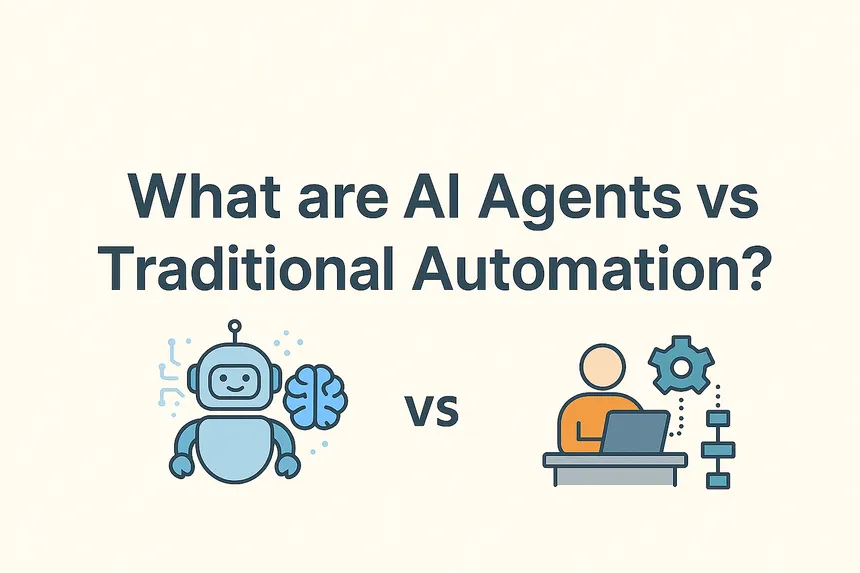
Table of contents
Every founder eventually hits the same conversation: someone on the team says “let’s automate this,” and the room quietly splits into two camps without realizing it. One person is picturing a rule that fires the same way every time, dependable and boring in the best sense. The other is picturing something closer to a digital employee, reading messy inputs and figuring out what to do with them. Both are describing automation. Neither is wrong. But building the wrong one for the job wastes months and money either way.
The confusion is understandable, because “automation” has quietly stretched to cover two genuinely different things: rule-following systems that execute a fixed set of steps, and AI agents that interpret unstructured input and decide what to do next. Knowing which one a given task actually needs, before a single line of workflow gets built, is one of the highest-leverage decisions a founder makes when trying to get operations off their own plate. In this guide, you will learn what actually separates the two, real examples of each, where founders most often get the choice wrong, and a practical way to decide which one a given task needs.
What Traditional Automation Actually Is
Traditional automation follows a fixed, predefined sequence of steps every time, with no interpretation involved: if a specific condition is met, a specific action happens, exactly the same way whether it runs once or a million times.
A new row appears in a spreadsheet, an email sends. A form gets submitted, a record gets created in a CRM. A payment fails, an alert fires in Slack. The logic is written once, by a person, and the system simply executes it faithfully, which is precisely why it’s so reliable for anything with clear, repeatable rules.
This is the same underlying idea behind robotic process automation, software that follows a predefined workflow rather than genuinely understanding what it’s doing, which is exactly why it’s explicitly distinguished from artificial intelligence even though the two get lumped together in casual conversation. The strength of traditional automation is also its limitation: it’s extremely reliable at exactly what it was told to do, and it has no ability to handle a situation nobody explicitly programmed for.
Real-world example: A founder sets up a rule that says, “If a new lead fills out the contact form, add them to the CRM and send them the pricing PDF automatically.” Every single lead gets the exact same treatment, instantly and reliably, because the rule never has to make a judgment call, it just executes the same three steps every time.
What an AI Agent Actually Is
An AI agent is a system that can interpret unstructured input, reason about what it means, and decide what action to take, rather than simply executing a fixed, predefined sequence of steps.
Where traditional automation needs an explicit rule for every situation, an AI agent can handle situations nobody specifically wrote a rule for, because it’s working from understanding rather than a lookup table. This class of system pursues goals and takes actions with a meaningful degree of autonomy, most often powered by a large language model that gives it the ability to read messy, natural-language input and figure out what should happen next.
The tradeoff is the mirror image of traditional automation’s tradeoff: an agent can handle far more variation and ambiguity, but it’s inherently less perfectly predictable than a fixed rule, since it’s making a judgment call rather than following an explicit instruction every time.
Real-world example: A founder sets up an AI agent to triage incoming support emails. Instead of following a fixed rule like “if subject contains ‘refund’, tag as billing,” the agent actually reads the full message, understands that a customer is frustrated about a delayed shipment and separately asking about a discount code, and routes and drafts a reply that addresses both things, something a fixed rule would have needed dozens of explicit conditions to even partially approximate.
Key Insight: The cleanest way to tell the two apart isn’t “how advanced the tool sounds,” it’s whether the task requires judgment. A traditional automation asks “did X happen? then do Y,” a question with one right answer every time. An AI agent asks “given this messy, specific situation, what’s the right response?”, a question where the right answer genuinely depends on the details in front of it. Founders who pick based on how impressive a tool sounds, rather than which of those two questions their task is actually asking, tend to either over-engineer something that never needed judgment, or under-power something that genuinely does.
Where Founders Most Often Get This Wrong
Using an AI agent for something that’s actually a fixed rule. Routing every invoice reminder through an AI agent, when “three days overdue, send this exact email” never needed judgment in the first place, adds cost, latency, and unpredictability for no real benefit.
Using traditional automation for something that genuinely needs judgment. Trying to handle every possible support email variation with an ever-growing list of if-this-then-that rules eventually collapses under its own complexity, exactly where an agent would have handled the variation naturally.
Assuming “AI” always means “better.” A fixed rule that runs the exact same way every time is often more trustworthy for anything tied directly to money or compliance, precisely because there’s no interpretation step that could go differently on a given day.
Never combining the two. Most real operations benefit from a fixed rule handling the reliable, repeatable 80%, with an agent stepping in only for the ambiguous cases that a rule genuinely can’t anticipate.
Skipping a trial period before fully trusting either one. Both traditional automation and AI agents can behave differently than expected under real, messy data, and a short supervised period catches that before it becomes a client-facing problem.
Traditional Automation vs. AI Agents: At a Glance
Aspect | Traditional Automation | AI Agent |
|---|---|---|
How it decides | Follows a fixed, predefined rule | Interprets input and reasons about the right action |
Best for | Repetitive tasks with clear, stable rules | Tasks involving ambiguity, nuance, or unstructured input |
Predictability | Extremely high, same result every time | Generally reliable, but inherently less than a fixed rule |
Handles edge cases | Only ones explicitly programmed for | Can often handle cases nobody anticipated |
Typical use | Invoice reminders, data syncing, scheduled reports | Email triage, lead research, drafting responses |
Setup effort | One-time rule, cheap to build and maintain | Needs more careful setup, testing, and oversight |
How to Decide Which One a Task Needs
Ask whether the task has one right answer every time. If it does, it’s a rule. If the right answer genuinely depends on the specific details of each case, it likely needs an agent.
Start with the fixed rule when in doubt. It’s cheaper, faster to build, and easier to trust, so it’s worth confirming a rule genuinely can’t handle the task before reaching for something more complex.
Reserve agents for the parts that keep breaking rules. If a workflow keeps needing “one more exception” added to it, that’s usually the signal the task actually needed judgment from the start.
Combine them where it makes sense. A rule can handle the reliable, repeatable path, and hand off only the genuinely ambiguous cases to an agent, which is how most mature systems actually end up structured.
Keep a human checkpoint on anything high-stakes. Whether it’s a rule or an agent making the call, decisions tied to money, legal exposure, or a client relationship are worth a review step before anything goes out irreversibly.
Key Takeaways
Traditional automation follows a fixed, predefined sequence of steps, extremely reliable for anything with clear, stable rules.
AI agents interpret unstructured input and decide what to do, able to handle ambiguity a fixed rule was never written to cover.
The real dividing line is whether a task has one right answer every time or genuinely depends on judgment call by call.
Most founders get the most value combining both, letting rules handle the repeatable 80% and agents handle the ambiguous exceptions.
“AI” doesn’t automatically mean “better,” a fixed rule is often the more trustworthy choice for anything tied directly to money or compliance.
Conclusion
The founders who get the most out of automation aren’t the ones chasing the most advanced tool for every task, they’re the ones who correctly matched the tool to the actual shape of the problem: a fixed rule where the answer never changes, and a genuine agent where it does.
Getting that match right the first time is what keeps a system fast to build, easy to trust, and cheap to maintain, instead of either over-engineered or quietly falling apart under real-world messiness.
If figuring out which parts of the business genuinely need a fixed rule and which parts need real judgment feels like its own project, that’s exactly the kind of assessment Rhinon Labs does for founders and SMBs, whether the business is B2B or B2C.
Rhinon Labs designs and builds the mix of workflow automations and AI agents that actually fits how a business runs, rather than defaulting to whichever sounds more impressive.
Frequently asked questions
Traditional automation follows a fixed rule with one right answer every time. An AI agent interprets input and makes a judgment call, so the right action can genuinely depend on the specific details of each case.
No. For anything with a clear, stable rule, tied to money, compliance, or anything needing perfect predictability, traditional automation is usually the more trustworthy choice.
Yes, and this is how most mature systems end up structured: a rule handles the repeatable, reliable path, and an agent steps in only for the genuinely ambiguous cases a rule can’t anticipate.
If a fixed-rule workflow keeps needing “one more exception” added to it over time, that’s usually the signal the task needed judgment from the start.
Generally, yes. A fixed rule is typically faster and cheaper to set up and maintain, which is why it’s worth confirming a rule genuinely can’t handle a task before reaching for something more complex.
Not for anything high-stakes. Decisions tied to money, legal exposure, or a client relationship are worth a human review step, whether a rule or an agent made the initial call.
Get an honest MVP assessment in 5 minutes.
We tell you what to build, what to skip, and what it'll actually cost. No fluff.
Assess My IdeaFree · 5 minutes · No obligation